Tattoo ideas
Tattoo ideas by style and placement — with the trade-offs artists actually talk about
8 styles, 8 placements, 64 combinations. Each page covers a realistic size range in centimetres, pain, how the combination ages, what artists commonly warn about, and three seed ideas you can turn into 3 concept directions to bring to your consultation.
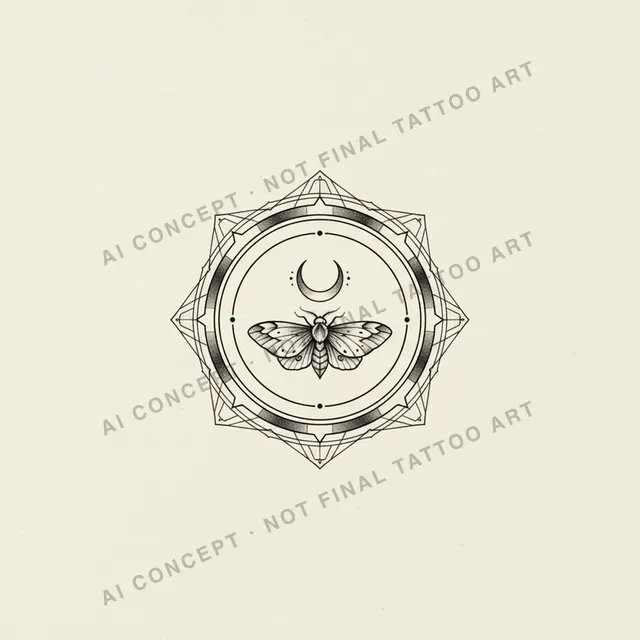
Anchored Emblem
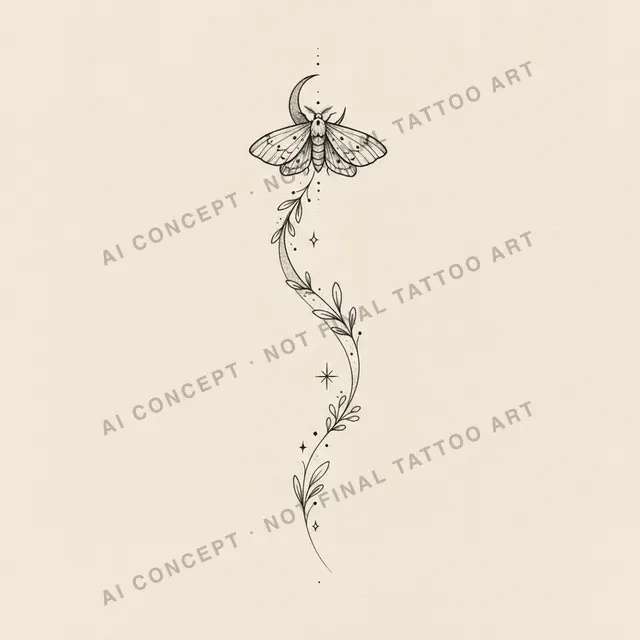
Organic Flow
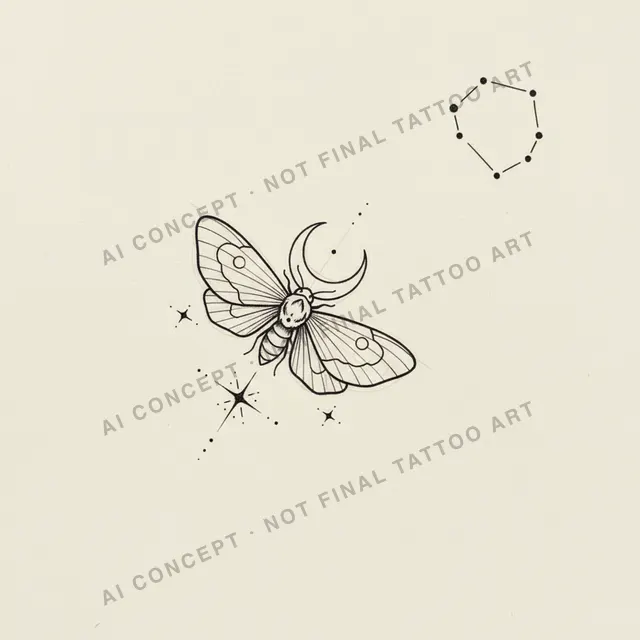
Minimal Structure
Styles
Style decides how the tattoo ages more than any other choice. Bold, saturated work lasts decades; light, diluted work needs a protected spot and a touch-up plan.
Fine line
thin, even single-needle linework
Fine line uses single-needle or 3-round-liner groupings for thin, even lines with little or no shading. It reads crisp when fresh but carries the least ink per line of any style, so lines soften and lighten noticeably over 5–10 years, especially where skin gets sun or friction. Artists warn that detail packed tighter than about 2 mm apart will blur into a grey patch as it heals, and that a fine-line piece under 5 cm rarely stays legible.
Min. readable size ~5 cm · longevity low
Blackwork
solid black fills and bold silhouettes
Blackwork means solid black fills, bold silhouettes and high contrast, from ornamental bands to large negative-space pieces. Solid black is the most stable ink on skin — it holds its shape for decades and can be reworked or expanded later — but large fills mean long sessions, more pain per hour and heavier scabbing if the skin is overworked. Artists warn that solid areas over 8–10 cm across usually need more than one session, and that a big black fill is close to impossible to lighten later.
Min. readable size ~4 cm · longevity high
Traditional
bold outlines, limited palette, readable at a distance
American traditional (old school) is built on bold black outlines, a limited palette — red, yellow, green, black — and simple, readable shapes. It has the best long-term track record of any style: heavy outlines and solid fills hold together as skin ages, which is why decades-old sailor tattoos are still legible. Artists warn against shrinking a traditional design below the size where its outlines can stay bold, and against asking for 'traditional but with thin lines', which ages like neither style.
Min. readable size ~6 cm · longevity high
Neo-traditional
varied line weights, wider palette, decorative framing
Neo-traditional keeps the bold outline logic of traditional but adds varied line weights, a wider palette, decorative framing and more dimensional shading. It ages well when the artist keeps a clear outline hierarchy; the risk is overloading detail, because the decorative fill is what blurs first. Typical pieces run 10–25 cm, and artists warn that it is labour-intensive — expect more than one session and a higher quote than a plain traditional piece of the same size.
Min. readable size ~8 cm · longevity medium
Dotwork
tone built from individual dots
Dotwork builds tone from individual dots instead of solid shading, giving a soft, engraved, almost printed texture. Dots stay put better than fine lines because each one is a small, well-saturated deposit, but they need breathing room — packed too densely they merge into flat grey within a few years. Artists warn that it is slow to execute (a palm-sized dense piece can take 3–5 hours) and that stippled gradients need a minimum size, usually 6 cm or more, to read as a gradient rather than a smudge.
Min. readable size ~6 cm · longevity medium
Realism
photographic light and texture, no outlines
Realism reproduces photographic light, texture and depth with smooth shading and no outlines. Without a black outline to hold the design together it depends on strong contrast: soft, low-contrast realism can lose definition within 5–10 years and read as a grey shadow. Most artists want at least 12–15 cm for a face to keep features legible, and they warn that black-and-grey realism ages better than colour, and that a realistic portrait is one of the least forgiving things to ask of an inexperienced artist.
Min. readable size ~10 cm · longevity medium
Watercolor
soft washes and splashes, usually with a linework anchor
Watercolor tattoos imitate paint: soft washes, drips, splashes and colour bleeding with few or no outlines. Diluted, light pigments are the first to fade — pastel washes can lose most of their intensity within 5–8 years in sun-exposed skin. It works best when a black-line or solid element anchors the composition and the washes are an accent; artists warn that pure outline-free watercolor is a touch-up commitment, and a poor choice for hands, feet or anywhere that sees daily sun.
Min. readable size ~8 cm · longevity low
Geometric
precise lines, repetition and symmetry
Geometric tattoos use precise lines, repeating shapes, symmetry and pattern — from sacred geometry to sparse linework arrangements. Precision is the whole point, so the style is sensitive to placement: straight lines and true circles distort on curved or moving parts of the body, and any spread of the line shows. Artists warn that parallel lines spaced under 2–3 mm apart will merge over time and that symmetrical designs must be stencilled against the body's own asymmetry, not against a flat drawing.
Min. readable size ~5 cm · longevity medium
Placements
Placement sets the size ceiling, the pain, the healing effort and how much sun and friction the ink will see for the rest of your life.
Forearm
pain 3–5/10 · 8–20 cm
The forearm is the most requested first-tattoo placement for good reasons: it is relatively flat, easy to see and photograph, low on pain (around 3–4 out of 10 on the outer side, more near the inner elbow and wrist) and quick to heal because it is easy to keep clean. Inner forearm skin is thinner and paler, so fine detail reads well but also shows sun damage sooner; the outer forearm is tougher and sees more sun. Artists warn that the forearm rotates — a design that looks straight with your palm down can twist when the arm hangs naturally — so the stencil is checked with the arm relaxed.
Upper arm
pain 2–4/10 · 10–25 cm
The outer upper arm — bicep and tricep — is muscular, padded and among the least painful places to be tattooed (around 3 out of 10), with wrap-around space for pieces 10–25 cm and a natural path to a half sleeve later. Skin here is thick, ages slowly and is usually covered by a T-shirt sleeve, which makes it a practical choice when workplace visibility matters. The inner bicep is a different story: thin, sensitive skin, higher pain and more swelling — artists warn that designs crossing from outer to inner arm will distort as the bicep flexes.
Wrist
pain 5–7/10 · 3–8 cm
The wrist is small, highly visible and busy: tendons, bone and constant movement mean higher pain (about 5–7 out of 10, worst on the inner wrist and the bony outer side) and slower healing where watch straps and cuffs rub. Realistic size is 3–8 cm, and a band or wrap-around must account for the wrist being thinner on one side. Artists warn that the inner wrist gets sun and friction all day, that fine detail there fades faster than almost anywhere else on the arm, and that most designs need to leave room around the wrist crease.
Shoulder
pain 3–4/10 · 8–20 cm
The shoulder cap is rounded, muscular and forgiving — pain around 3–4 out of 10, thick skin, quick healing — and it gives a natural circular or radial canvas for pieces 8–20 cm across. It hides under a T-shirt but shows in a tank top, and it is the standard starting point for a sleeve or a chest-to-arm piece. Artists warn that the deltoid curves in two directions at once, so anything with straight edges or strict symmetry needs adapting, and that the top of the shoulder is a high-sun area unless you cover it.
Chest
pain 4–8/10 · 10–30 cm
The chest offers a wide, fairly flat area for symmetrical or paired compositions 10–30 cm across, but pain varies sharply: the pecs are moderate (4–5 out of 10) while the sternum and collarbone are among the most painful spots on the body (7–8). Skin here is thick, rarely sees sun and barely moves, so tattoos hold up well and precise work is possible. Artists warn that chest skin changes with weight, muscle and — for women — pregnancy, breastfeeding or surgery, and that designs crossing the midline must be stencilled with your arms hanging in a neutral position.
Back
pain 4–7/10 · 6–45 cm
The back is the largest, flattest canvas on the body: the shoulder blades and upper back are moderate pain (4–5 out of 10), the spine and lower back higher (6–7). It takes anything from a 6 cm piece between the shoulder blades to a full back piece over 40 cm, and it almost never sees sun, so pigment holds for decades. Healing is the practical problem — you cannot see it, sleeping is uncomfortable and it takes discipline to keep it moisturised; artists warn that the shoulder blades move independently, so a single design across both will shift when you reach forward.
Thigh
pain 2–5/10 · 10–30 cm
The outer thigh is one of the least painful placements (2–3 out of 10), with a large, gently curved surface that takes pieces from 10 cm to 30 cm and beyond. It is easy to hide, easy to heal — loose clothing helps — and the skin is thick and rarely sun-exposed, so detail lasts. The inner thigh is more sensitive and rubs against the other leg while healing; artists warn that thigh skin shifts with weight and muscle change, and that a front-of-thigh design should be checked standing, not lying down.
Hand
pain 6–8/10 · 3–8 cm
Hands are the most exposed skin you have: constant washing, sun and friction mean tattoos here fade and blur faster than anywhere else, and touch-ups are expected rather than exceptional. Pain is high (6–8 out of 10, worse over the knuckles and the side of the hand), healing is awkward because you cannot rest the area, and detail spaced under about 3 mm does not survive. Many artists limit hand work to bold, simple designs of 3–8 cm and some decline hands or fingers on a client with no other tattoos; they also warn that hand tattoos can still affect employment in some fields.
All 64 combinations
Fine line
Blackwork
Traditional
Neo-traditional
Dotwork
Realism
Watercolor
None of this replaces a consultation. Pain, sizing and ageing vary with your skin, your artist's technique and your aftercare — every page here ends with your own tattoo artist, not with an image. See also: how to write a tattoo design brief · preview placement on your own photo
For tattoo artists
Your clients arrive prepared. You stay in control.
Structured briefs, region comments, approvals, and quote-to-deposit flow — without giving up a single stroke of your final design. AI never trains on your work.